
Are you familiar with the wildfire mitigation strategies in your city? In Anchorage, certain techniques known as fuel treatments have helped reduce fire risk.
Alaska has natural resources of many kinds—fish and wildlife; oil and gas and metal deposits; thousands of lakes and rivers; and scenic beauty and wilderness areas, to name some. ISER researchers study many facets of the state’s natural resources—and forces that affect those resources—including commercial, subsistence, and sport fisheries; land and wildlife management issues; health of ecosystems; threats from invasive species; and people’s response to environmental change and risk.
Read More
Increased wildfire activity has raised concerns among communities about how to assess and prepare for this threat. There is a need for wildfire hazard assessment approaches that capture local variability to inform decisions, produce results understood by the public, and are updatable in a timely manner. In this article, Schmidt and her co-authors describe how, in partnership with wildfire practitioners and communities, they created a tool that rapidly assesses wildfire hazards and is easily modified to help identify and prioritize mitigation activities.
Read More
The Institute of Social and Economic Research (ISER) faculty, including Brett Watson, Bob Loeffler, and Mary Kopriva, showcased their expertise as panelists at the Alaska Resource Development Council annual conference held in Anchorage on No
Read More
ISER Faculty Member Jennifer Schmidt partnered with Toby Schwoerer at the University of Alaska Fairbanks and Jim Powell at the University of Alaska Southeast on a study of threats from climate-related hazards to homeowners in Fairbanks and Anchorage.
Read More
Please join a panel of experts and keynote speaker, Professor John Ball from South Dakota State University, for the Anchorage Tree Forum on September 20, 2023, 6:30PM-9PM at Wendler Middle School. Bring your questions and ideas to discuss urban tree health, invasive species, Firewise and more.
Read More
Proposal Numbers: UAF: 2318384/ UAA: 2318385
Project Title: Collaborative Research: NNA Research: Electric Vehicles in the Arctic (EVITA) - Interactions with Cold Weather, Microgrids, People, and Policy
Read More
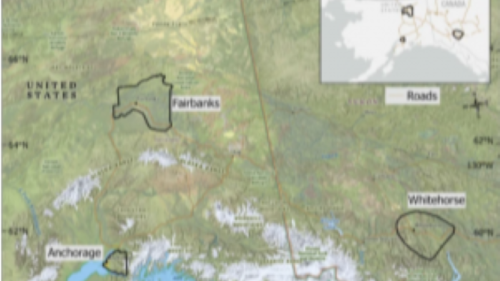
In this paper we modified an existing landcover dataset to better identify vegetation associated with wildfire and permafrost in Fairbanks, Anchorage, and Whitehorse over the past 4 decades (1984-2014) and make predictions for the next 4 decades (2024-2054). We used an existing fire model called FlamMap and several statistical analyses to determine where future fires could be possible.
Read More
Alaska Food Strategy Task Force member, Mike Jones, discusses food security with The Talk of the Kenai podcast.