The school year is over, and ISER researchers are studying which Alaska educators choose to come back to their jobs next year – and why. Researchers from the Center for Alaska Education Policy Research (CAEPR) presented updated teacher and principal turnover numbers, as well as preliminary findings from their statewide educator survey, at the Alaska State Board of Education on Wednesday June 3.

We study the K-12 educator workforce, the role of K-12 and postsecondary education in developing Alaska’s workforce, education funding, and the unique contexts for delivering education across Alaska’s diverse communities and geographies.
News
Read More
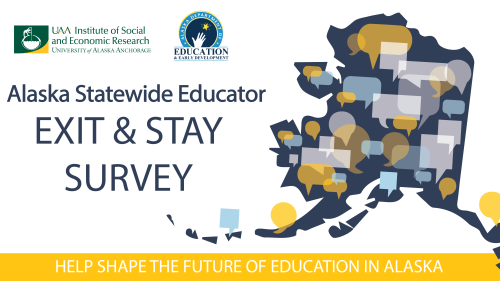
CAEPR is currently running a statewide educator survey!
The survey was developed in collaboration with education shareholders. It is a confidential survey that asks educators about their school and work experience, their community, themselves, and their future plans.
In early February, every in-service educator in Alaska received a personalized email survey invitation. We will send reminders to teachers periodically over the next 8 weeks, and develop a report in June.
We are excited to do this in service of schools and communities in our state.
Read More
On March 12, Brock Wilson presented to the House Judiciary Committee on federal employment in Alaska. During the presentation, he discussed key insights related to the economic contributions of federal civilian workers in Alaska, emphasizing the role federal employees play in critical industries and the state's economy. His focus was on analyzing the reliance on federal workers, the impact of potential reductions in federal employment, and how these changes could disproportionately affect Alaskan industries.
Read More
ISER researchers Matt Berman and Dayna DeFeo have released a new report updating their previous analyses of Alaska’s current per-pupil education spending. The report is available here: http://hdl.handle.net/11122/15717
Read More
Across the Arctic, schools struggle to meet the needs of all students, especially Indigenous students and those who have learning disabilities. Education systems are needed that allow students to study in institutions grounded in their own cultures and languages, regardless of whether they are newcomers or Indigenous, and that prepare them to succeed regardless of learning differences.
Read More
In this new ISER report (https://scholarworks.alaska.edu/handle/11122/14906), ISER economist Matthew Berman and CAEPR director Dayna DeFeo explore how Alaska teacher salaries compare to the national average, adjusted for cost of living differences. They also examined trends in salaries of Alaska and US teachers adjusted for inflation over the past several decades, and how the salary differentials have changed over time.
Read More
The public is invited to an education policy forum titled: “Funding Education in Alaska: Lessons and Insights from Local and National Research” on February 8, 2024, at 5:00 pm in the Egan Lecture Hall room 112 on the UAS campus in Juneau. This free event, co-sponsored by the UAS School of Education and the UAA Institute of Social and Economic Research (ISER), features Dr.
Read More
This is a list of recent publications and reports by CAEPR and ISER focused on school finance, teacher workforce issues (recruitment, retention, and turnover),and related topics. This represents only a small portion of the education-related products from CAEPR and ISER. All CAEPR/ISER reports are available on the web at Scholarworks@UA, and you can see many of our peer-reviewed journal publications on journal websites or via the UAA/APU Consortium Library.
Read More
On Thursday, December 7th, ISER hosted a Helen and Edward Gorsuch Public Policy Forum titled "Public Education Funding in Alaska: What we know, what we don't and how other states do it".
Read More
New research from ISER’s Trang Tran and Dayna DeFeo examined how relationships influence rural Alaska students’ transitions from home communities to postsecondary institutions. Their analysis identified characteristics of the transition processes that seem particular to rural students—in navigating urban places and cultural norms, seeking institutional supports, advocating for self, and forming new social relationships. In all of these experiences, rural identities and community-oriented values emerged as a guiding force for students’ goal-setting, decision-making, interactions, and adjustment.
Projects
No results.
Publications
People

Dayna DeFeo, Ph.D.

Diane Hirshberg, Ph.D.

Trang Tran, Ph.D.
Mailing Address
3211 Providence Drive, RH 228
Anchorage,AK 99508